Pressure Switches for Power Capacitors

Power capacitors are central elements of modern energy infrastructure: deployed wherever DC is converted to AC or vice versa, for grid stabilization and reactive power compensation. The hermetically sealed housing contains metallized films. At end of life, gas forms and internal pressure rises. The pressure switch detects this increase and disconnects the capacitor from the grid. Without this protective function, housing failure, explosions, or cascade failures in series connections are imminent.
Pressure Switches for Power Capacitors

Typical Application Areas

Wherever capacitors stabilize grids, on land and at sea:

Substations

Wind Turbines
Offshore

Trains

Application Case 01

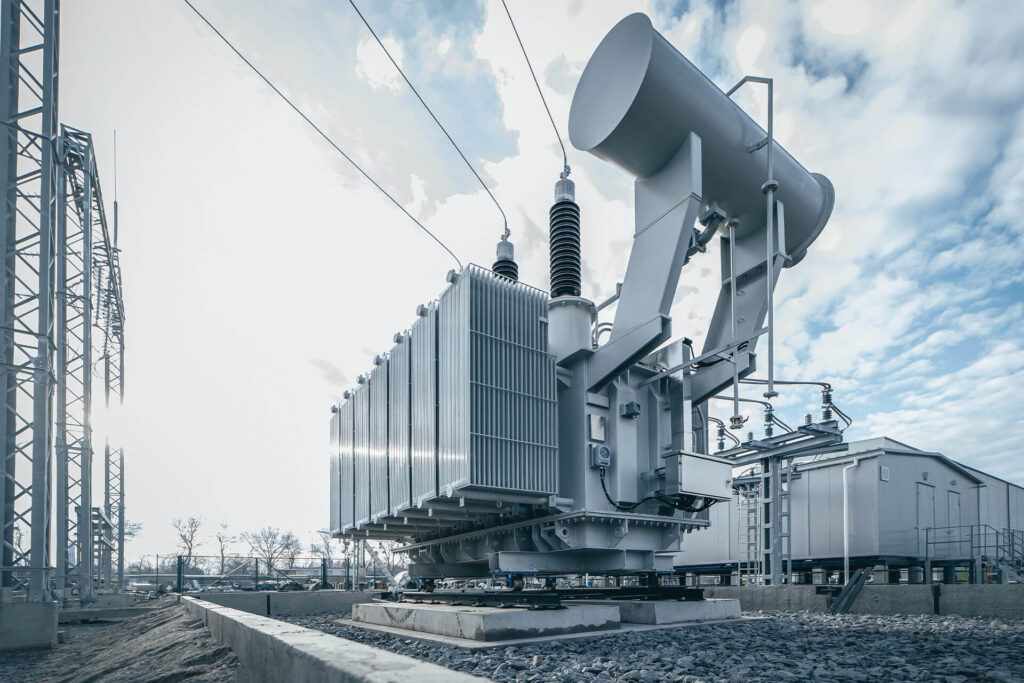
Substations – Ensuring Grid Stability

In substations, each power capacitor is connected to its own pressure switch. It detects the critical pressure rise in the sealed housing and initiates grid disconnection, often after decades on standby. A switch can remain in the system for up to 30 years without triggering once, yet must function when needed. For this reason, we deliberately avoid aging-prone elastomers and rely on stainless steel membrane and gold-plated solid silver contact rivets. Because the switches are usually mounted outdoors, robust housings and cable outlets with high ingress protection are added. Typical switch points are below 500 mbar; single-operation switching of 0.4 A at 110 VDC is required.

Why our pressure switches are ideally suited:

Application Case 02

Trains – Compact Design with High System Responsibility

In rail vehicles, power capacitors are an integral part of the power converters. Here, the same protective mechanism operates under significantly tighter conditions. The power capacitors are part of the power converters, installation space is limited, and vibration, temperature fluctuations, and high electrical requirements are added. The compact design of our pressure switches also fits where space is scarce. What is critical is that the switch operates reliably after years of inactivity and safely disconnects the capacitor from the grid.

Why our pressure switches are ideally suited:

FAQ

Frequently Asked Questions

In the event of a fault, gas can form inside a power capacitor, causing internal pressure to rise. The pressure switch detects this pressure increase and provides an electrical signal when the defined switch point is reached. This signal can be used to disconnect the affected capacitor from the grid and prevent further damage. The pressure switch thus performs a specific protective function within the capacitor.

In this application, even a comparatively small pressure increase must be reliably detected. At the same time, installation in the capacitor places special demands on construction and materials. Our design developed for this purpose therefore uses a stainless steel membrane and is specifically designed for low switching ranges. This allows the required switch point to be achieved with a construction that does not require an elastomer membrane in the pressure-transmitting area.

In capacitor monitoring, the critical switching operation may only occur after many years—just once at the end of the capacitor’s service life. However, the contact must then function reliably and, depending on the application, may switch high electrical loads up to 110 VDC. For this reason, we use gold-plated solid silver contacts. The gold plating protects the contact surfaces from environmental influences and surface changes during the long standby period. This is particularly important because power capacitors are used under very different conditions—from desert regions to rail vehicles to offshore installations. The solid silver contact then provides the necessary basis for the actual switching operation.

The pressure switch is matched to the respective capacitor design. Critical factors include the desired switch point, the maximum pressure encountered, the mechanical installation situation, as well as contact function, voltage, current, and electrical connection. Together with the customer, we determine the appropriate design so that the pressure switch can be integrated structurally and electrically into the capacitor’s protection concept.

CUSTOMIZED PRESSURE MONITORING

Precision for Every Application